Thursday, 3 March 2011

The Irish Diaspora


I thought I would begin this blog with a photograph, partly to add content but also to test out a little bit of software. I have tried to upload photos before but they have failed and latterly I have learned that the file size may have been too big, just too much detail for blogger to handle, apparently an image on the internet does not need to be as 'intense' as an image for, say a glossy colour brochure. So my bit of software can reduce the number of pixels in the photographs so that they can be uploaded much more quickly but still be viewable.

As a consequence of being in the tourism business we get bombarded with information from one source or another, the Northern Ireland Tourist Board has three publications, The View, Tourism Eye, and the Tourism Spotlight, who these are intended for and how the content differs I don't know. We get another publication from 'TIL' , (Tourism Ireland Limited) which is the organisation charged with marketing Ireland on a whole Island basis, there is also Failte Ireland which is responsible for marketing the South of Ireland and I am sure that they have a raft of in-house publications as well.

What I notice is that the most important person in this chain is often overlooked, namely the visitor, is there any publication or E-zine that they can sign up to and be kept informed about happenings within Ireland north and south. It is a bit like the now infamous debate we had in our local council last month, the Tourist Board were admirably funding the erection of new sign-age for a coastal route around the Mourne Mountains, and it came before the local Council for approval.
Here, however, rather than welcoming this development, the issue became the language that the signs were to be in, the Tourist Board were funding signs in English only, but some of our Councillors in their wisdom thought that they should also be in Irish and just as readily a few more thought that they should then also be in Ulster Scots. I think the fundamental point was missed, if language was to be an issue, it should have been which language would most have met the needs of our visitors, German, French, Dutch perhaps?

Back to the matter of those publications, as mentioned TIL, remember who they are?, have a publication called Contact, and apart from the usual range of photos of people in suits standing beside pull-up banners there is some good information, as indeed there is in all the publications, just do we need so many? One article caught my eye, it is a campaign to connect with people of Irish Ancestry throughout the world using twitter, you can read more about the article by clicking on this link, apparently the best tweet will get a 140 hour short break in Ireland.


The magical 140 figure comes from the maximum characters you can use in a tweet, you would think I would know what I am talking about, but I haven't a clue really, however next week I have planned some training on social media. This campaign to connect with the Irish Diaspora, as it is called, ie Irish people spread across the world can be checked out on an associated website


Monday, 21 February 2011

Fairy Thorns

Here at Tory Bush we are considering making the biggest hanging basket in County Down, really it is making use of some steel work we inherited, I will photograph the project as it goes on and post a blog later when all the flowers in bloom, if they do bloom that is, Jim and I are not exactly what may be called green fingered, lets say thank goodness for the recent wet summers we have had.

Jim is the handy man here at Tory Bush and from all those that have stayed the consensus is that he does a fantastic job. Talking about wet summers, about three years ago we decided to put window boxes on all the cottages and houses on site and at the time we made a device to attach to a hose pipe to enable us to water the boxes on the first floor windows, but would you believe it given the nature of the last few summers we have not had to use it once. Some may be thinking for a business trying to sell holidays in Northern Ireland talking about wet summers is not doing a good job, but I don't believe anyone books a holiday in Northern Ireland on the basis of guaranteed sunshine, I believe our mild moist climate gives us other attributes in terms of vegetation, or peat covered mountains and of course the moniker the 'Emerald Isle', I also think it reflects in our personalities, the easy going nature of the people.

Johnny Cash had a song called The Forty Shades of Green , and believe me there is forty shades and many more. The song was a tour through Ireland from well known place to another but making no geographical sense.

I close my eyes and picture the emerald of the sea
from the fishin boats at Dingle to the shores at Donaghadee
I miss the River Shannon and the folks at Skibbereen
the moorlands and meadows and their Forty Shades of Green

But most of all I miss a girl in Tipperary town
and most of all I miss her lips as soft as eiderdown
I long again to see and do the things we´ve done and seen
where the breeze is sweet as shalimar and there´s Forty Shades of Green

I wish that I could spend an hour at Dublin´s churning suft
I long to watch the farmers drain the bogs and spade the turf
to see again the thatching of the straw the women clean
I´d walk from Cork to Larne to see those Forty Shades of Green

But most of all I miss a girl in Tipperary town
and most of all I miss her lips as soft as eiderdown
I long again to see and do the things we´ve done and seen
where the breeze is sweet as shalimar and there´s Forty Shades of Green


However back on track, we were walking through the grounds at Tory Bush trying to find a place to locate the biggest hanging basket in Ireland ! !, yes I am making that claim now, and we came upon the Fairy Thorn that is located at Tory Bush and I thought that I had never blogged about the tree so here goes. From old maps there was a fence, wall or hedge down through the field in front of the cottages, we have replaced that boundary albeit a few metres further out into the next field, but when ever the original boundary was removed there was a thorn tree at the start of the boundary and it was never taken away with the rest of the wall or hedge or what ever was there. There is a big superstition about Fairy trees here in Ireland and people won't cut them or indeed dig them up. When I began this blog I 'googled' Fairy Thorn just to get some background and the following link is the first I came across http://ghosterelle.blogspot.com/2006/03/fairy-thorns-interview-wbarry.html and believe it or not I remember very well the incident mentioned in the second paragraph where an electricity sub-station had to be relocated because of the accidents surrounding the removal of the Fairy Thorn.

The local story was that after the first person broke their leg trying to remove the tree and after the remainder of the workmen refused to work on the boss said 'poppy-cock' or words to that affect, 'I will do it, let me in that digger' and as he hurriedly climbed the steps of the excavator in his muddy wellingtons he slipped and broke his leg. I don't know if as many as four people broke their legs but there was at least two.

What my little bit of research did show is that the belief is more prevalent in Northern ireland as the following online definition shows.

fair·y thorn (plural fair·y thorns)


noun
Definition:
Northern Ireland hawthorn bush: a hawthorn bush left growing in the middle of a field through fear that misfortune would befall whoever chopped it down

Tuesday, 18 January 2011


I like to start a blog with a photograph and here is one I made earlier, literally!! I built these pillars a number of years ago and had the gates made in a traditional 'Ulster Style' by Walker Brothers of Ballyward. The round hoops are not only decorative but to add strength to the gate to stop it sagging. The hoops are made by the Walkers using a set of Rollers that have been in their black-smithing family for generations. The rollers are like an old fashioned 'Mangle' http://en.wikipedia.org/wiki/Mangle_(machine) used to dry clothes except that in this case there are 3 rollers and the straight metal bar is fed in on it's edge, as the curvature of the hoop is increased the rollers are screwed in closer and the bar is fed in a second or third time. Like all these skills and traditions they are at risk of dying out, in mass production gate manufacture these hoops would be cut out of sheets of steel using Lasers I presume. I have taken this photo from the Northern Ireland Tourist Board Library and apparently we, ie people in the Tourism trade, are permitted to use these photos, but why then I wonder is the NITB logo still in the middle of the photo. I think it a bit of an irony that they claim copyright to the image but I had a major contribution in the formation of the image, funny I was aware of that when I was building the gate and pillars; that they would be used to frame photographs of the Mournes.

By the way, talking of gates sagging, the correct way to climb a gate, if it has to be done at all, is to climb it on the hinge or hanger side this avoids putting a strain on the gate and causing it to sag. The current advice in 'gate construction' is to cement a flat stone tightly under the locking side of the gate so that if it is climbed on that side the potential damage is limited.

I was checking out some material on the BBC website http://www.bbc.co.uk/ and came across a great resource based on a programme called 'Your Place and Mine' which is a local BBC Northern Ireland programme broadcast every Saturday morning from 8.00 a.m. to 9.00a.m. and has 12 regional reporters from towns and regions right across the country.

It appears that whatever story the programme covered they added it to their website with more information and audio clips of the original programme. One of the best of these is the feature on the tunnellers who formed the tunnel under the Mourne Mountains to divert the Annalong River to top up the Silent Valley Reservoir in order to maintain a supply of water to the ever avaricious City of Belfast. To view this material click on the link below and see where it takes you


Monday, 15 November 2010

Mourne Mountains, a great description. As promised, here is that description of the Mournes, if you can forgive the initial spelling mistake.

Mourn Mountains

The Mountains of Mourne are hands-down the most spectacular mountains in Ireland. The mountain range is located in Northern Ireland in County Down, specifically in South Down. The best way to reach the Mourne Mountains is to head down to the seaside resort of Newcastle. This exquisitely-located, bustling little town serves as a great home base for mountain expeditions. The Mournes are the most frequently visited and hiked mountains in Ireland.

The land on the south side of the mountains is known as the Kingdom of Mourne. Due to its isolated location, the kingdom developed a distinct culture and society. The region’s main industries were farming, fishing, and granite. The Mournes are some of the best granite mountains in Ireland, and granite quarries were a huge part of the Kingdom of Mourne economy. Mourne granite can be found throughout Ireland and England, including Belfast, Liverpool, London, and Manchester.

The rugged, granite peaks of the Mourne Mountains add a majestic element to the surrounding golden beaches, deep forests, and emerald fields. The beauty of the mountains was immortalized in one of WIlilam Percy French’s songs. French, an Irish songwriter, wrote the song with a chorus of “Where the Mountains of Mourne sweep down to the sea.” The Mourne Mountains of Ireland have actually been internationally recognized as an Area of Outstanding Natural Beauty. The mountains boast better hiking, rock-climbing, and walking than found at any of the other Northern Ireland Mountains. Some well-known mountains include Slieve Donard, Slieve Lamagan, and Slieve Muck. Slieve is from the Irish word ‘sliabh,’ meaning mountain. Besides visits to these majestic Ireland mountains, tourists can trek up to the Mourne Wall, a man-made, dry-stone wall built between 1904 and 1922. The reason for its construction was to provide work during a period of high unemployment. The wall is 2 m high, a meter thick, and over 35 km long, and it lies across the summits of 15 of the surrounding peaks.

In the center of the Mourne Mountains of Ireland, weary travelers can rest at the stunning Silent Valley Reservoir. Formed by the damming of the Kilkeel River so as to provide Belfast with water, the Reservoir has scenic walks, a pleasant coffee shop, and a shuttle bus service that can take people up the valley to the Crom Dam.

During at trip to this region, visitors can also enjoy cycling, golf, horseback riding, fishing, and helicopter rides. Several parks and natural attractions are located near the Mountains of Mourne. The Castlewellan Forest Park is a good choice for beginning hikers and campers, with gentle walks, brilliant castles, and excellent trout fishing in its shimmering lake. Equestrians, both beginners and experienced riders, can arrange for beach and forest horseback trips at the Mount Pleasant Horse Trekking Centre.

In Newcastle and the Mourne Mountains, there are a number of accommodations available. New Youth Hostel is centrally situated, and the Beach House is a delightful Victorian Bed and Breakfast just opposite the beach. Several other B&Bs and hotels are located in the center and outskirts of Newcastle. Camping is always popular, especially in summer months. The Tollymore Forest Park, with tent and caravan sites, is located about 3 km northwest of Newcastle.

The Mourne Mountains of Ireland offer a breathtakingly beautiful combination of sand, surf, meadow, and mountain. The Mournes are the most famous of the Ireland Mountains and visitors can hike, climb, golf, fish, horseback ride, and simply soak in the superb natural views of these jagged peaks rising high above shimmering seas and fields.

How others see us.

I have a facility on my computer called Google Alerts which lets me know during the period of a week if the term Mourne Mountains is used on the Web, either on a new website, a blog or an online article say from a newspaper. Anyone can use this facility via Google for any interest they may have, eg 'Line dancing', 'Origami', ' Neil Diamond' ,' Formula One racing', 'Humane Slaughter', or London Transport; now one of the previous is actually another of of my alerts, I will let you ponder on which.

Well the content below is a description of Northern Ireland from a website that is trying to sell 'Vacations' Worldwide, I don't know where it is based but I think it has used a generic description of Northern Ireland written in their own language and then used an online translation facility to translate it back into English. This has led to the word Metropolis being used instead of City when referring to Belfast and the Giants Causeway being described as the Good Causeway. It makes for a fun read but the essential message is still there.

"One or more of the four countries of the United Kingdom is Northern Ireland. This 14,000-square-mile area has a temperate oceanic climate. English Irish and its official languages, although their dialect of English has been influenced by the Scottish.

Northern Ireland has a great scenic mountains and one of the most famous may be the Mourne Mountains. This has been the inspiration of the famous author CS Lewis in his novel Children The Chronicles of Narnia. Numerous activities can be as the famous Mourne Mountain conducted a walk, hiking, fishing, horseback riding and more.

The water resources and networks are also a paradise in Northern Ireland. Several rivers and do Lough (lake) are as Bush River and Lough Neagh scattered throughout the country, where you can travel especially cruising, fishing or take it by foot or bike.

be far more than 40,000 of polygonal columns of basalt layers, which are guided by a volcanic eruption happen to the interest of tourists visit the good Causeway. The mean Percentage of the coastal road offers a breathtaking perfect hexagonal layers. This led to the Causeway declared a World Heritage Site by UNESCO.

The capital Metropolis, Belfast, can be the household with the famous ship Titanic. Located in the center of the city, the Cathedral Quarter in the center of attention of culture, architecture and Cooking was. Belfast is also the world-class interactive Science Discovery Centre, the W5, in addition to the ancient yet vibrant and colorful St. George's Market. The Metropolis is also home to a large number of gourmet restaurants, chic bars and shopping centers.

The Walled City of Derry, the only surviving in Ireland, is a of the largest walled cities of Europe. The landmark building, popular walls and panoramic views Foyle charm lots of visitors. The targeted visitors for free and relaxing trails and roads from the Foyle Valley, it produces an award-winning bike path.

Where do you want to travel in the world? For an idea of where to go on your next vacation, visit famouswonders.com. While you are on the site, also take a look at things to do in Ireland."

Coincidentally on Google Alerts, two weeks ago, I came across a description of the Mourne Mountains on another world wide Vacation site and it is one of the best I have ever seen, I hardly recognised the place and I live here. I will post this on a second blog; the only down side is that the have titled the article 'MOURN Mountains'


Sunday, 31 October 2010

Turn any Stone

There is an expression we have here in Northern Ireland,'Turn any Stone and there is a story', and it is almost true. I guess we are a small country with a long history, a varied geology and a culture of myths and legends.

What brings me to this topic is the film about Burke and Hare that is on current release, coincidentally for me, in that it is directed by John Landis who directed American Werewolf in London and the 15 minute long video for Michael Jackson's Thriller, both of which I saw as part of the Halloween celebrations by Newcastle Community Cinema, a small community driven cinema that puts on interesting films once or twice a month usually on a Friday night, worth checking out if you are staying in the area.

However back on message, Burke and Hare were both Irish, Burke was born in Strabane in1792 and Hare was born in Scarva possibly in the same year, they both reputedly worked on the construction of the Newry Canal, the first canal dug in Britain since the Romans, 20 years before the famous Bridgewater Canal that brought coal into Manchester and often cited, incorrectly, as the first canal in Britain; coincidently the Newry Canal was also constructed to move coal from the coal fields in Tyrone to the port of Newry, we even have a town called Coalisland in Tyrone.

See, there goes that 'Turn any stone' thing again, not any canal but the first in Britain, our own Coal mines.

I heard a local historian on the radio today mention that Burke and Hare worked on the Newry Canal but by my reckoning it was finished a good 50 years before they were born, perhaps they worked on it's extension or a branch, in any case the used this experience of working on canals to move to Scotland to work as navvies there. Being a 'Navvie' as it is known, from the term Navigation Canals would be with out doubt hard work, cutting trenches through solid rock on occasion, Burke and Hare soon spotted an easier way to make money using there digging skills.


Edinburgh had a well renown Medical School and Medical Science was becoming important as a study, medicine was moving away from the old Apothecary to the beginning of modern Medicine, Jenner had just discovered vaccination, Davy had developed the first anaesthetics, the first stethoscope was made in 1816, and the first blood transfusion in 1818. Doctors could now be trained, but, just as they do to this day, they needed cadavers to study anatomy but just as the demand increased the supply decreased. Up until the 1800's the source of dead bodies were people hanged for committing crimes, and under what became known as the Bloody Code, lots of crimes could be punishable by death, hanging for pick-pocketing was only repealed in 1808, writing a threatening letter could be a hanging offence. At one time there were 222 crimes punishable by death, but in more enlightened times Judges started to find people not guilty as they knew a guilty verdict was certain death, and combined with the repeal of these laws and the increased use of transportation as the 'punishment of choice' the numbers of bodies declined to only a few actually guilty of murder.

The word got out that the Medical schools would pay well for recently deceased bodies and so began the practise of Grave Robbing, where a freshly interred corpse would be dug up and sold to the Medical Schools, on a 'ask no questions be told no lies basis'. Burke ad Hare saw this as an opportunity to make use of there digging skills and for that matter the digging was easy, not rock but freshly backfilled soil.

The Percy French song 'The Mountains of Mourne' has a few lines about the naive Mourne Man in London coming across people digging in the streets, obviously digging pipe trenches etc but they spin him a yarn,

They don't sow potatoes nor barley nor wheat
But there's gangs of them diggin' for gold in the street.
At least, when I asked them that's what I was told
So I just took a hand at this diggin' for gold;

Well Burke and Hare did take ' a hand' a the digging and got as well paid as if they had been digging for gold, they got paid up to £10 per corpse, the average workers wage at the time was £1 per week. But that was not enough for these two entrepreneurs, whether it was all that digging or that it was becoming more difficult to get into graveyards, guards were being employed and cages were being erected over fresh graves and left until decomposition would have set in, but Burke and Hare decided to short circuit the process by killing there own bodies. In all they killed 17 persons and were only caught when they left a body under a bed in a lodging house kept by Hare's wife Margaret and one of the other lodgers returned unexpectedly to search for some clothing.

The evidence against the pair was weak but the Lord Advocate in Scotland offered Hare immunity if he would confess and testify against Burke which he readily did. Burke was hung in January 1829 and with a touch of irony he was publicly dissected in Edinburgh Medical College.

Hare was released the same year and began a nomadic life, some say he was blinded when thrown in a pit of lime and for a time was a blind beggar in London and last seen living in Carlisle. At some point he must have made his way back to Northern Ireland because he is buried in Kilkeel, something I need to check out for myself.

Talk about turn any stone, from a Gravestone in Kilkeel to a a blockbuster film by a leading Hollywood director.

A little foot-note Hare is not a common name here in Co Down and Co Armagh, but O'Hare is and I would assume that was Hare's correct name but it may need a little research just as I would like to link the O'Hare name here with that of O'Hare Airport in Chicago, named after a WWII flying Ace Edward 'Butch' O'Hare, interestingly the son of Al Capone's lawyer Joseph O'Hare who helped provide evidence against Capone on his tax evasion charge, and there lies another interesting story, the subject of another blog I think.


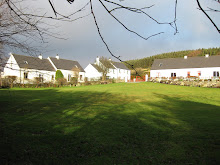


Tuesday, 26 October 2010

"Leave as found", puppy dogs and babies.

We use the term "Leave as found" in our terms and conditions, which is basically a request to leave the cottage on departure as clean as it was found on arrival. A not unreasonable request we think as we believe the affordable pricing of self-catering, based on a per person per night price, from as little as £12 per night even in peak season, is a trade-off between us the provider and the guest where the servicing tasks are shared. This is opposed to the fully serviced provision in Hotels, Guest Houses etc where the higher price includes an element to clean up after the stay.

We take the meaning of the term Self-Catering in it's fullest sense where guests 'cater' for themselves, not only by cooking for themselves but also cleaning for themselves. Now we don't expect guests to leave the houses spotless but we do expect them to make some attempt to tidy up. What causes me to raise this topic is the way some guests left one of the cottages on departure today, they just walked out leaving the house in a 'right state'. It appears that they cleaned nothing from arrival and just let their children run riot with breakfast cereal all over the floor and other foodstuffs walked into the floor. Thank goodness we have durable tiling on the downstairs living spaces, if we had carpets we would not stand a hope.

We pride ourselves on how clean we prepare the houses and this matters greatly when we have a number of turn-a-rounds on busy days such as Saturdays in July and August when we could have as many as 17 properties to clean in the 5 hours between departures at 11.00 a.m.and the new arrivals at 4.00p.m., so that trade-off really comes into it's own.

I don't what this blog to become a rant, I think it is the exception that makes the rule and the truth is that the vast majority of guests leave the properties as they found them, so it really stands out when some don't, I believe it shows a degree of dis-respect for my cleaners and my property.

On the topic of how guests leave properties, we often come across items left behind, the most common is the humble telephone charger. These are often plugged into sockets in bedrooms or behind furniture, so are often over-looked on departure. I can't think of the most unusual we have come across but a colleague in the self-catering business has the best story. After some guests left she was preparing the house for new arrivals when she came across a puppy sleeping in the bottom of a wardrobe, I don't know if the guests ever reclaimed the puppy, but thank goodness the cottage owner was a dog lover. It reminds me of a story some nurse friends told me in London, one of them was working in a maternity hospital and this extended family came to collect the new mum and baby. It was the nurses final responsibility to carry the baby down out of the Ward to the exit and hand it over to the departing parents. On this occasion so many of the extended family had arrived, grandmothers, aunts, uncles, siblings that by the time they all clambered back into the small Nissan Sunny, new mum and all, they closed the door and drove off and left the nurse standing holding the baby. I would like to say they were half way across London before they realised, but I think they only got as far as the hospital gates.